AI agent orchestration for business explained in plain English: what it means, when a single agent is not enough, and how to spot a production-grade system.
AI agent orchestration for business is the coordination layer that turns a handful of separate AI tools into one system that finishes a job end to end, instead of stopping at the first step and waiting for a human to carry it forward. If your business runs a chatbot on the website and an automation that files support tickets, you already have agents. What you probably don’t have is orchestration, and that gap is where most 2026 AI projects stall.
TL;DR: Orchestration is the layer that lets multiple AI agents hand work to each other, remember what’s already happened, and recover when a step fails, rather than each agent working in isolation. Most businesses don’t need it yet. You need it once a workflow requires several distinct skills, a persistent record of state, and reliability without a human checking every step.
What Orchestration Actually Means
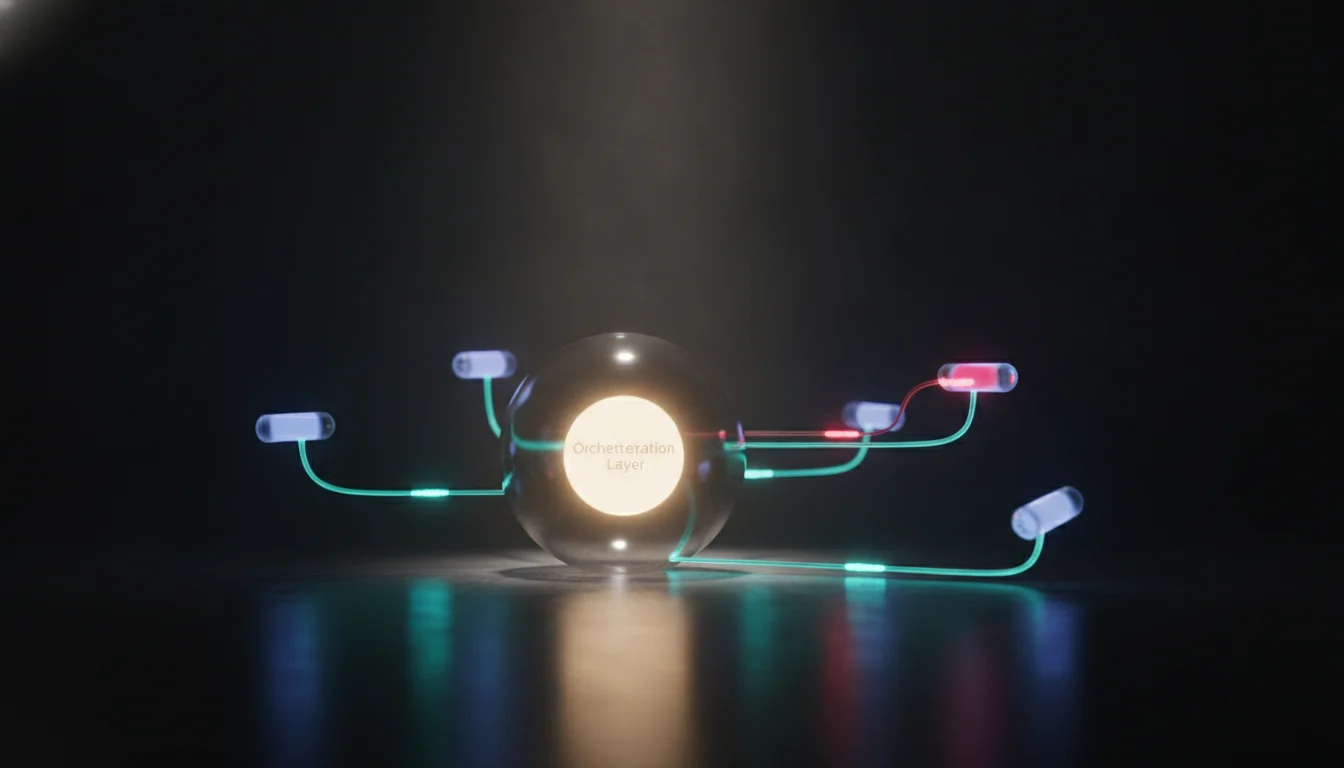
A single AI agent does one job: answer a question, draft an email, summarise a document. Orchestration is what happens when several agents work together on something bigger than any one of them can finish alone. Picture a lead qualification workflow: one agent reads an inbound enquiry and extracts intent, a second checks it against your CRM and pricing rules, a third drafts a personalised reply, and a fourth schedules the follow-up call. Orchestration is the layer above all four that decides what happens next, passes context between them, and knows what to do when step two comes back with an incomplete answer.
Three capabilities separate orchestration from a chain of scripts:
- Task decomposition: breaking a broad request into steps that individual agents can actually complete
- State persistence: remembering what’s already happened across a workflow that might run for hours or days, not just within one conversation
- Failure recovery: retrying, escalating to a human, or rerouting when an agent gets a bad result, instead of the whole workflow silently dying
None of this is new in software terms; workflow engines have always done it. What’s changed is that the “workers” are now language models making judgment calls rather than fixed logic, which is why coordination is harder than it looks from a demo.
The Tooling Has Matured Fast
The platforms have caught up to the idea. LangGraph, built by the LangChain team, gives developers explicit control over stateful, branching agent workflows and has become a default choice for systems that can’t afford to fail silently. CrewAI takes a different approach, assembling role-based agents into a “crew” that collaborates toward a shared goal; the package now pulls more than 5 million downloads a month on PyPI, a rough proxy for how many teams are actively building with it. n8n added an AI Agent node with looping, tool-calling, and a guardrails step, putting orchestration within reach of teams without an engineering function. Microsoft Copilot Studio has pushed into enterprise territory, with governance and audit trails built in rather than bolted on.
Building an orchestrated system in 2026 is no longer a research project. It’s an engineering decision, and increasingly a business one.
When Your Business Needs AI Agent Orchestration (And When It Doesn’t)
Not every business needs this, and pretending otherwise is how AI budgets get wasted. A single well-built agent is the right answer when the job is narrow, inputs are predictable, and a human is still reviewing the output. If your chatbot answers FAQs and hands off anything unusual to a person, you don’t need orchestration. You need a better chatbot.
You’re in orchestration territory when a workflow spans multiple systems, needs to persist state across a longer time horizon than one session, and must run reliably without someone babysitting every handoff: an order-to-fulfilment process touching inventory, payment, and shipping, or a recruitment pipeline that screens, schedules, and follows up on its own. Gartner’s June 2025 research warned that more than 40% of agentic AI projects will be cancelled before the end of 2027, citing escalating cost, unclear return on investment, and weak risk controls, not failed technology. Most of those cancelled projects were likely orchestration attempted before the business case was clear. If you’re unsure which category you fall into, a short strategy assessment is cheaper than building the wrong thing first.
Demo Versus Production: What Actually Changes
A demo is a happy path: someone types a clean request, every agent responds correctly, and the workflow finishes in thirty seconds on a laptop. Production is everything the demo skipped, from a CRM API timing out to two workflows updating the same record at once to needing proof, months later, of what an agent decided and why. Production-grade orchestration means logging every decision, defined escalation paths to a human, cost ceilings so a runaway loop doesn’t rack up API charges overnight, and testing against edge cases rather than the scenario that looked good in the pitch. That’s why so many orchestration pilots impress in a meeting and then quietly get shelved.
Building This the Right Way
AI agent orchestration for business is a real capability shift, not a buzzword to bolt onto existing automation. Businesses getting value from it started with a clear-eyed view of where a single agent was enough and where the workflow demanded coordination, state, and recovery logic across multiple agents. Get that assessment wrong and you end up funding one of Gartner’s cancelled projects. Get it right and the system keeps working after the demo ends.
If you’re weighing up whether your business has outgrown a single chatbot or automation, Avatar Studios’ AI & Automation team can help map the workflow, decide whether orchestration is warranted, and build it so it survives real customers and real edge cases, not just a pitch deck.
Frequently Asked Questions
What is AI agent orchestration in simple terms?
It’s the coordination layer that lets multiple AI agents work together on one task, passing information between them, remembering what’s already happened, and recovering when a step fails. A single chatbot answers questions; an orchestrated system completes a multi-step process end to end.
Do small businesses need AI agent orchestration?
Most don’t, at least not yet. If your workflow is narrow and a human still reviews the output, a single well-built agent is usually the better, cheaper choice. Orchestration earns its cost once a process spans multiple systems and must run reliably without constant supervision.
What’s the difference between n8n, LangGraph, and CrewAI?
n8n is a visual, no-code platform suited to teams without engineering resources. LangGraph gives developers precise control over stateful workflows for mission-critical builds. CrewAI uses a role-based model where agents collaborate like a team, popular for faster builds.
Why do so many AI agent projects fail or get cancelled?
Gartner’s 2025 research found more than 40% of agentic AI projects are expected to be cancelled by the end of 2027, largely due to escalating costs, unclear business value, and weak risk controls, not failed technology. Most failures trace back to skipping the assessment of whether orchestration was needed before building it.
How do I know if my business needs a single AI agent or a full orchestrated system?
Ask whether the task touches more than one system, needs to remember context over hours or days, and must complete without a person checking every handoff. If the answer is yes, you’re likely past the point where a single agent is enough.